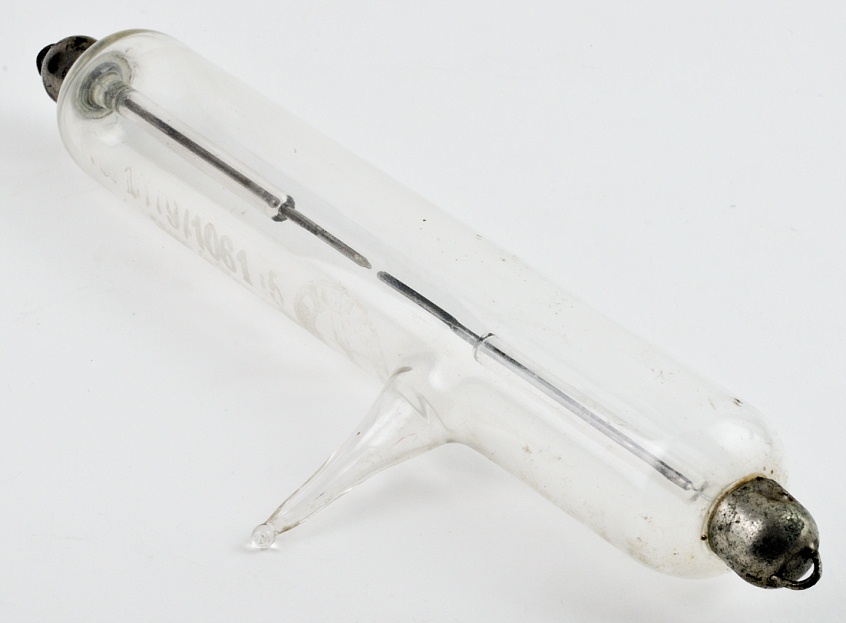
Cuthbert Andrews Gehrcke Cathode Glow Oscillograph
Oscillographe de Gehrcke
Glimmlicht-Oszillograph nach Gehrcke
Cuthbert Andrews, Manufacturer of Scientific Apparatus in Metal and Glass. 47, Red Lion Street,
High Holborn, London.
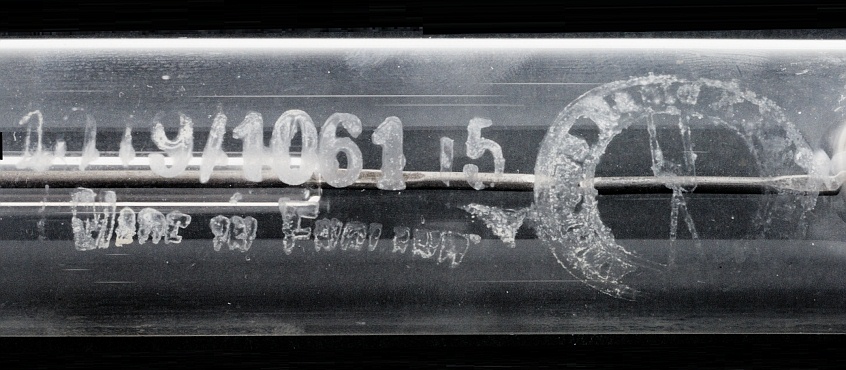
Marking: Andrews Rapid X-Ray Tube 1019/1061 15.
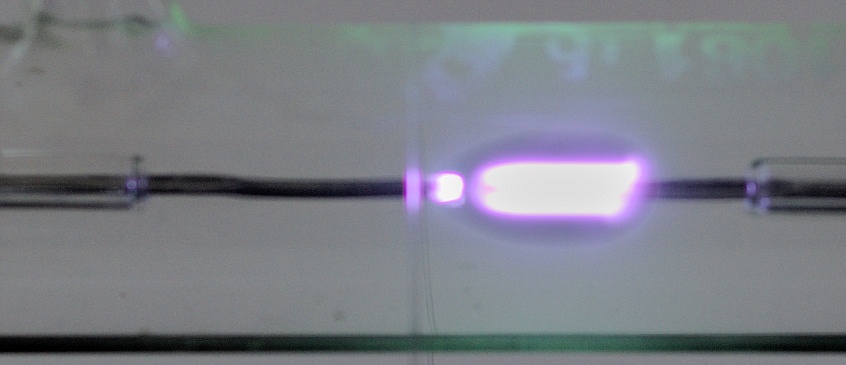
A precursor to the modern oscilloscope, an apparatus built in the early 1900s for the visual study of
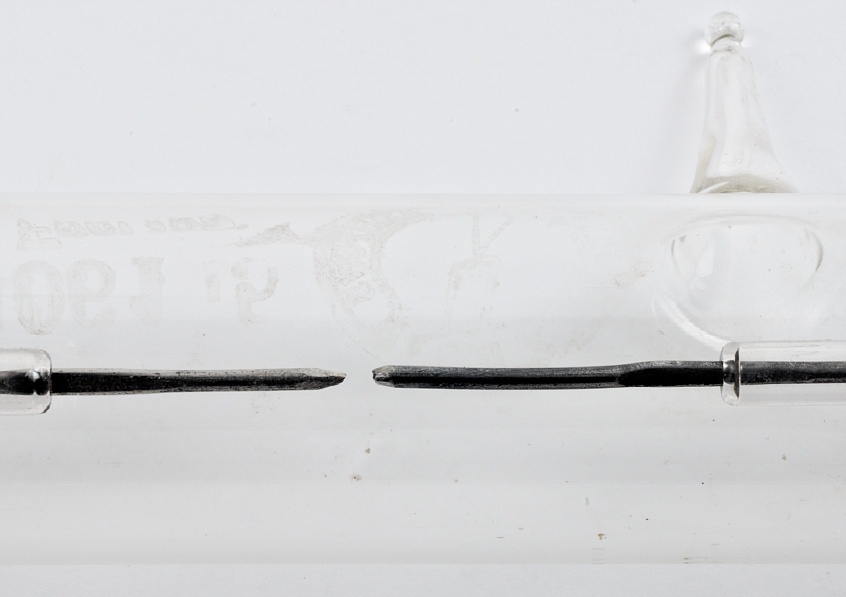
alternating current characteristics. In operation, the cathode is covered for part of its length with a blue glow,
the coverage depending on the applied voltage. The distance that the glow extends along the electrode is a function
of the instantaneous value of the potential of the electrode. When an alternating potential difference of 750 to 1500
volts is used, and the electrodes are viewed in a rotating mirror, the potential wave form is clearly seen.
Example of use: the detection of reverse currents in ionic X-ray tubes. These tubes must be protected
against inverse discharges flowing from the X-ray tube's anode to its cathode, as this could be disastrous in radiography
because the resulting X-ray images would be blurry.
If the current discharges in one direction, only one of the oscillograph wires shows the violet light, but if each wire is
alternately negative and positive, both wires become fluorescent and the length of the fluorescent band indicates the
intensity of the current, so that it is possible to compare the relative strength of the closing and breaking currents.
THE GLOW-LIGHT OSCILLOGRAPH, by P. M. Dysart
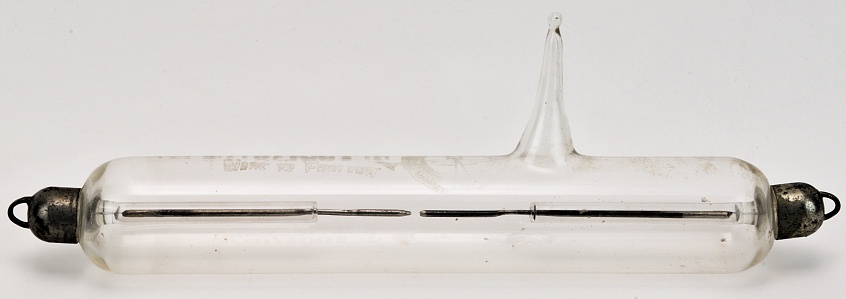
Longueur • Length • Länge : 192 mm • 7" 1/2
Diamètre • Diameter • Durchmesser : 27 mm • 11/16"
Le contenu de ce site est sous copyleft  The content of this site is under copyleft Der Inhalt dieser Website steht unter Copyleft



