 |
|
|

|

|

|

|

|
|

|

|

|
|
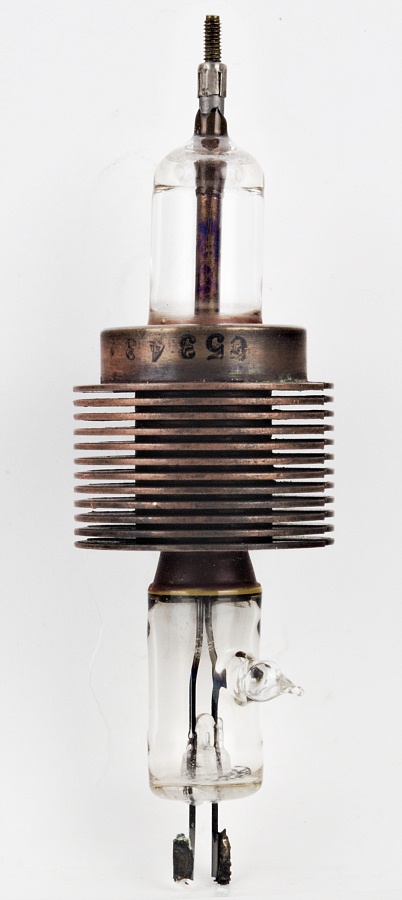
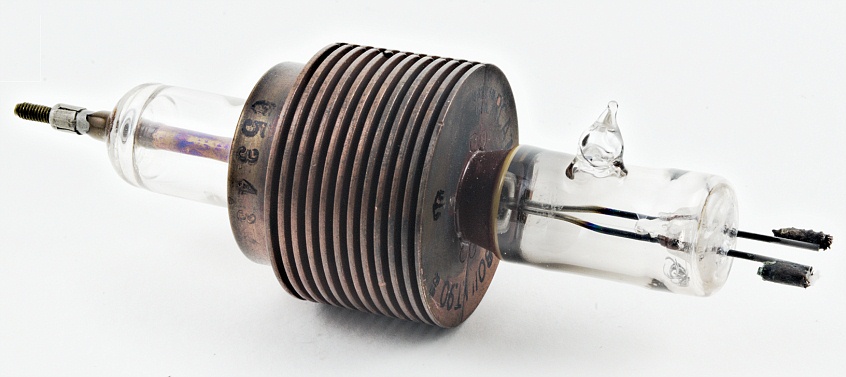
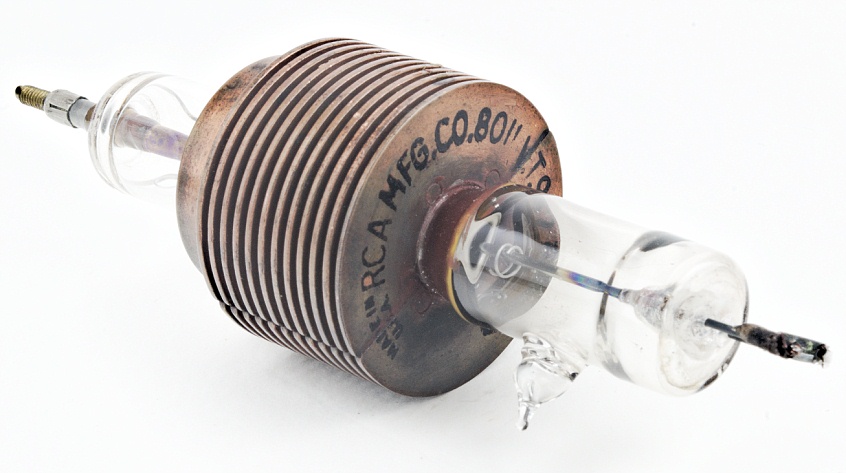
RCA VT.90 'Micropup' UHF Transmitting TriodeDeveloped in 1939 at GEC with the experimental code E1046, the VT90 was the first valve that made pulsed, airborne centimetric radar possible. This VHF triode operated up to 300 MHz (wavelengths around 100 cm) with 100 W plate dissipation with forced-air cooling and over 5 A emission under 9 kV pulses. Also coded as 10E/97, 10E/97B, approved as CV46, CV62 or CV1090 (depending upon the use and the specified screening tests), the VT90 saw widespread use in airborne interception (AI Mk II) and air-to-surface vessel (ASV Mk II) radars. American equivalents, as the 710A, the 8011 and the REL Type 1, were used in the US sets SCR-521 and ASE-1, and in the AN/ARQ-II airborne radar jammer. • J. Bell et al., Triodes for Very Short Waves - Oscillators, Journal of the I.E.E., Volume 93, Issue 5, 1946. • Colin MacKinnon, Production of VT90 (710A) Valves in Australia, The AWA Review, Volume 7, 1992. • Datasheet: CV1090.pdf.
Hauteur • Height • Höhe : 12,8 cm • 5"
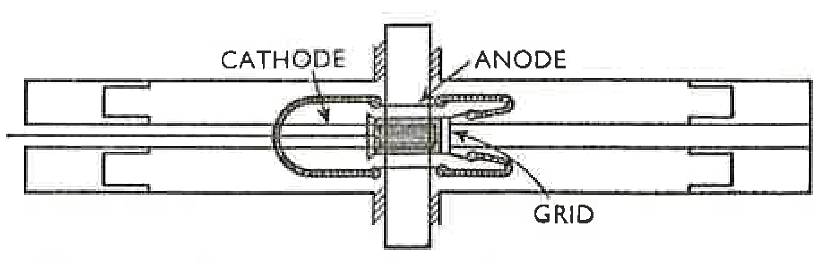
Diagram of VT90 mounted in its coaxial circuit.
Le contenu de ce site est sous copyleft |

 The content of this site is under copyleft