Tubes hyperfréquences - divers
Microwave tubes - miscellaneous
Mikrowellenröhren - Sonstiges
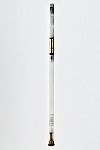
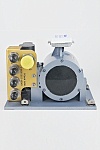
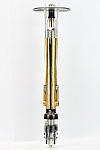
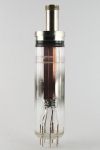
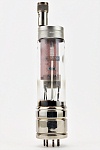
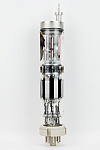
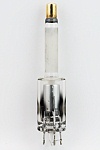
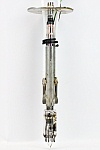
Backward wave oscillator (BWO)
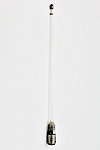
Also called carcinotron, a BWO is used to generate microwaves up to the terahertz range
with a wide electronic tuning range. It has two main subtypes, the M-type, the most powerful, and the O-type.
The output power of the O-type is typically in the range of 1 mW at 1000 GHz to 50 mW at
200 GHz. Carcinotrons are used in research, civilian and military (airborne radar jammers) applications.
Clipper diode
A specialized diode designed to limit, clip, or suppress voltage spikes in high-power
electronic circuits.
Heil tube
Velocity modulated high-frequency tube created in 1935 by Oskar Heil and his wife.
Heil tubes can be AM or FM modulated. Their efficiency is poor, in the order of 10 %, the reason why they
became soon outdated in favor of the most versatile klystrons. Anyway, Heil oscillators were investigated during
WW II as possible microwave sources in radar applications.
Inductive output tube (IOT)
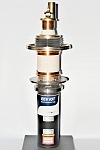
Also called klystrode, the IOT is a variety of linear-beam tube, similar to a klystron,
used as a power amplifier for high frequency radio waves. It evolved in the 1980s to meet increasing efficiency
requirements for high-power RF amplifiers in radio transmitters. The primary commercial use of IOTs is in UHF
television transmitters, where they have mostly replaced klystrons because of their higher efficiencies
(35 % to 40 %) and smaller size.
Monitor diode
Typical applications include the continuous monitoring of RF power, the direct viewing
of RF power pulse envelopes and the detection of irregularities in magnetron or modulator performance.
Noise diode
A noise source used to generate predictable, broadband white noise for testing and
calibrating radio frequency and microwave receivers, amplifiers, and systems.
Platinotron
Also called crossed-field amplifier (CFA) or amplitron, it is a velocity-modulated tube,
similar in operation to a magnetron and capable of providing relatively large amounts of power with high
efficiency. In contrast to the magnetron, the CFA has an odd number of resonant cavities coupled with each other.
Spark gap
Sealed spark gaps were used in early radars to operate as switches, to discharge a charged line
through the magnetron, so generating the high-power radio frequency pulses. Spark gaps were also used as protective
devices to prevent excessive voltage build-up in the modulators or even as gas switches in antenna duplexers.
 |
 |
 |
 |
 |
 |
 |
 |
1B42 |
2D2S |
2D7S |
302-H |
6D3D |
7159 |
A5022A |
BS502 CV6005 |
 |
 |
 |
 |
 |
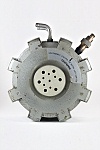 |
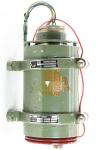 |
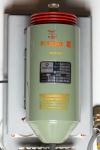 |
BS510 CV6107 |
CV1881 |
CV228 (V246A/1K) |
CV2341 |
CV6023 |
CV6124 = CMA1232 |
F4029C |
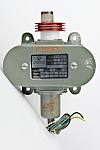
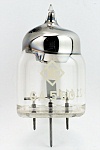
Thomson-CSF F4029E |
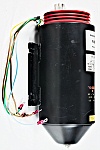 |
 |
 |
 |
 |
 |
 |
 |
Thales F4029E |
F4053 |
GA560 |
GSh-2 |
GShP-3G-1 |
HRO301 (= RWO2) |
IOT8303 |
K50A |
 |
 |
 |
 |
 |
 |
 |
 |
K81A |
MIU-49 |
MU-11A-1 |
NE17 CV359 |
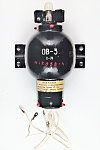
OV-3 |
OV-24 |
RK7531/QKB747 |
QKL1631-A3 |
 |
 |
 |
 |
 |
 |
 |
 |
SE-215-6 |
TD-124 |
Thomson-CSF BWO |
UMI-201 (MIU-50) |
Unknown BWO |
Unknown BWO |
Unknown BWO |
Unknown Noise Source |
 |
 |
 |
 |
|
|
|
|
V243A/2FS (CV5463) |
WJ-2019-50 |
WJ-2021-7 |
XD-9A |
|
|
|
|
Le contenu de ce site est sous copyleft  The content of this site is under copyleft Der Inhalt dieser Website steht unter Copyleft



